
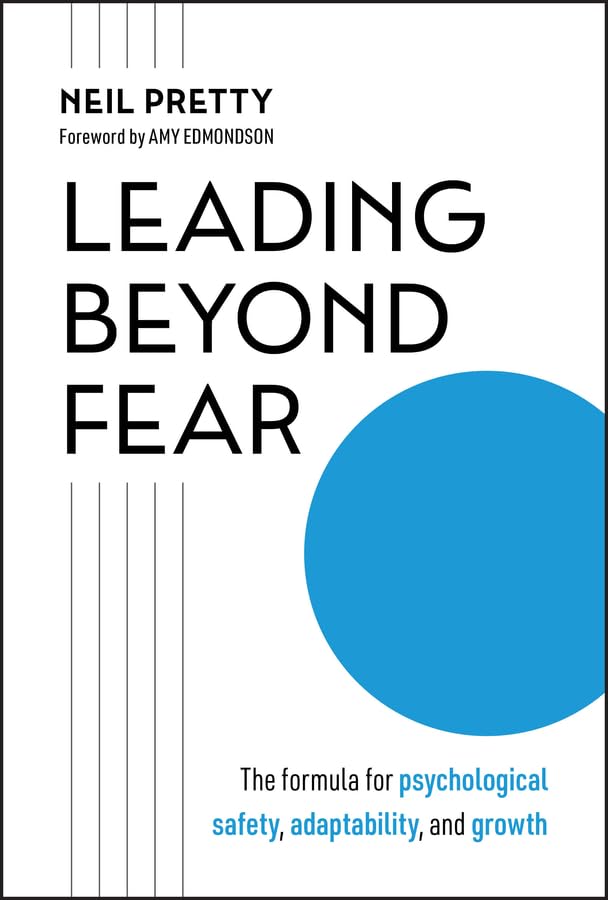
What is important about this book
Even leaders are learners, and learning means moving from knowing to doing. Knowing that psychological safety matters is not the same as knowing how to build it. The challenge leaders face is closing the gap between awareness and implementation: turning psychological safety into everyday leadership practices that enable learning, adaptability, innovation, and performance.
As we interact with each other to accomplish shared goals, we are at the same time trying to feel safe, valued, accepted, and secure. Humans are wired to belong, and the brain constantly scans the environment for signals of safety or threat. When the brain anticipates negative social consequences, people tread carefully, manage impressions, or withhold ideas. Over time, this leads to silence, hidden mistakes, and missed opportunities. When people feel safe enough, they share their thoughts, contribute positively to the team’s challenges, challenge the status quo, and, in doing so, enable leaders to benefit from the talents and ideas of team members.
Psychological safety is not the finish line—it is the foundation. It is not about comfort, complacency, avoiding conflict, or diluting feedback. It creates the conditions for healthy, constructive tension, learning, innovation, and performance. But safety alone is not enough: it needs to be channeled into action, experimentation, accountability, and growth. Leaders can help create these conditions through connection, curiosity, compassion, and courage.
Neil Pretty is the co-founder of Aristotle Performance and a leadership consultant who has worked with organizations in more than 25 countries on 6 continents. He’s an experienced leader and entrepreneur. Pretty’s work is focused on helping leaders build psychological safety as the foundation for high-performance, adaptability and innovation.
Quotes
- “Organizations and leaders that fail to prioritize psychological safety risk losing their competitive edge. Turnover, disengagement, and stagnant innovation are indicators of deeper cultural deficiencies”.
- “Psychological safety creates the foundation for healthy, constructive tension that drives performance and innovation”.
- “If you want people to focus on high-minded efforts, they can’t be thinking about survival at the same time”.
- “When psychological safety is low, invest in strengthening the social fabric. When it is high, you can drive harder toward innovation and performance”.
- “Psychological safety is neurobiological. Leaders who remain calm and curious in their responses-especially to challenge—make it easier for others to access their courage. Safety isn’t just felt. It’s training, moment by moment”.
- “When you cultivate psychological safety at the grassroots level, it doesn’t just elevate individuals—it reshapes the entire system”.
- “You need to learn your way through problems by trying new things, taking what works, and leaving behind what doesn’t”.
- “When you articulate a clear “why,” you move people out of resistance and into relevance. You help them see that this isn’t just a random shift—it’s a meaningful step forward”.
- “Applying a human-first approach to psychological safety means looking beyond just removing the sources of fear”.
Structure and contents of the book
The book opens with two forewords: one by Amy C. Edmondson, Harvard Business School professor and the leading scholar on psychological safety, and one by Dr. Anita Polite Wilson, leadership and organizational development expert. The introduction provides context on psychological safety and moves from theory to practice, preparing the ground for the practices that follow.
The first two chapters explore the nature of psychological safety—from our primal need for safety and interdependence—and the elements to lead: choosing a new leadership style, owning your role, and recognizing that leadership is often a matter of context.
From there, the architecture follows a deliberate progression. Leading Yourself addresses the inner journey, exploring courage, calm, clarity, humility, confidence, empathy, perspective-taking, and learning. The next chapter moves from the inner game to the outer game, from “me to we”: framing and reframing, expectations, feedback, inquiry, listening, dialogue, facilitation, decision-making, discernment, prioritization, and negotiation. This is where the book moves decisively from mindset to application, introducing practical techniques, frameworks, and processes that leaders can adapt to their own situations. These capabilities are then brought into one-on-one and group interactions, including meetings, check-ins and team relationships.
Finally, the perspective expands from individual interactions to the senior leader as a culture architect, shaping organizational norms, change, measurement, leadership development, and the systems that enable broader growth.
Instructions for reading this book
This is a book for Leaders, Executives, HR Business Partners, Learning & Development, People & Culture professionals, and Culture Architects—as well as new Team Leaders. It is not a one-size-fits-all manual: its practices are meant to be adapted to different organizational contexts.
Do not read it simply to learn more about psychological safety. Use it to close the gap between knowing that psychological safety matters and changing how leadership happens in practice. Read it first to understand the broader concepts and frameworks, or go directly to the section that matches the challenge in front of you. Keep it on your desk and return to it when meetings are not working, decisions are not being made well, people are not contributing, dialogue gives way to talking at people, or teams are struggling to interact.
Think of its contents less like a pyramid and more like a periodic table of leadership elements: pick the elements you need, create experiments, observe the results, and learn from them. Use the practices to replace control with curiosity, listen more deeply, and create the conditions for co-creation, reflection, challenge, and discovery. The goal is not a quick fix: test, reflect, adapt, and practice consistently until the book becomes exactly what Pretty hopes it will be—a tool that is “dog-eared and worn at the edges”.