
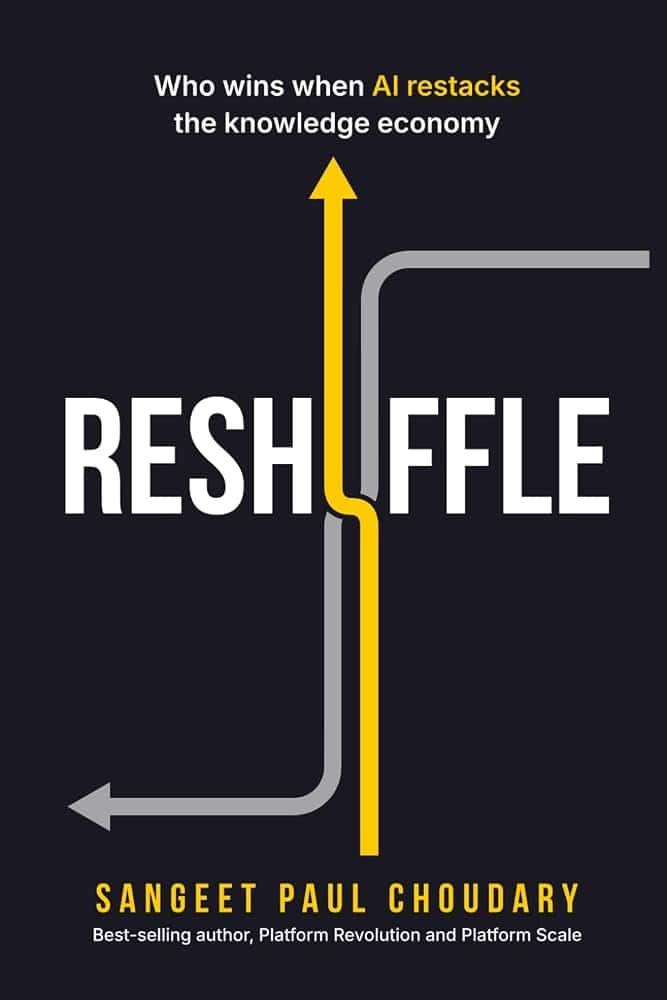
What is important about this book
AI is reshaping the economy, transforming how value is created and how work is performed. Machines haven’t become more intelligent in a human sense, but they‘ve become increasingly capable and performant in specific, economically valuable ways, offering adequate substitutes for human performance without necessarily replicating human thought. The fundamental mistake is judging AI by how human it seems, rather than by what it can do. This intelligence distraction keeps us from focusing on the economic and systemic implications of its actual capabilities.
The economic impact of AI is determined less by the complexity of the tasks it performs and more by how it transforms the systems in which it operates. Work is not simply a bundle of tasks but a response to constraints in a larger system, and when constraints shift, the value of work migrates with them. New winners and losers emerge, not despite a growing pie but precisely because of it.
Today’s coordination mechanisms are excellent at managing structured, repeatable processes but struggle with activities requiring consensus in uncertain environments. This is precisely why AI matters: not so much as a tool for improving productivity through automation, but as a mechanism for coordinating what has so far remained uncoordinated. AI is better understood not as an alternative to human intelligence, but as a practical tool that integrates into our workflows and restructures how we make decisions and act.
Sangeet Paul Choudary is a best-selling author and C-level advisor on AI and platform/ecosystem economics who has advised CEOs at more than 40 Fortune 500 firms. With Reshuffle, he won the 2025 Thinkers50 Strategy Award.
Quotes
- “The real impact of Al comes not from how it performs a task, but from how it restructures the entire system around that task”.
- “Winning with AI requires shifting from optimizing tasks to reconfiguring how the entire system works. Adopting AI won’t create an advantage unless you redesign your organization to leverage it effectively”.
- “AI’s value lies less in automating tasks and more in enabling new architectures of coordination and decision-making”.
- “The automation vs. augmentation debate distracts us from the real shift: whether a role remains meaningful in a restructured system”.
- “Jobs are design artifacts of a specific system of work. When that system changes, role relevance and structure must be revaluated”.
- “AI dissolves the false trade-off between team-level autonomy and their org-wide organization. Rather than choosing between team freedom and organizational alignment AI enables both to reinforce each other”.
- “Al doesn’t merely offer a better way to play the same old game. It offers an opportunity to reimagine the playing field in your favor”.
- “The most valuable companies today don’t own the means of production; they own the means of coordination”.
- “Coordination grows the pie, but it also changes who gets to keep which slice of it”.
- “The real promise of AI is not in surviving the reshuffle but in mastering it in our favor”.
Structure and contents of the book
The book is structured in three sections that follow the arc of AI’s impact, from how we think about it, to how it changes how we work, to how it restructures competitive advantage and power. From the overlooked brilliance of the shipping container to the F1 pits that dethroned Schumacher’s dominance, he unearths a powerful pattern: the most transformative technologies do not merely automate, they transform entire economic systems.
Section I – “AI and the System” reframes the mental models through which we understand AI. AI is not merely a tool of automation or substitution, but a force that transforms the economic logic of any system by changing how value is created and distributed, and how these changes reallocate power.
Section II – “Work and Organizations” zooms in on the world of work and the opportunities and limitations introduced with AI. Many tasks that once commanded high value may decline in relevance, while new points of leverage emerge elsewhere in the system. The real opportunity for workers is to track where value is headed and position themselves in its path.
Section III – “Competitive Advantage” examines how AI restructures competitive advantage, how it elevates new winners and eliminates previous ones, and how it changes the very logic of an industry. Reshuffle unpacks the four key tensions driving this transformation:
- between workers and their tools,
- the providers of these tools and the firms that use them,
- the businesses consolidating power and the industries they disrupt, and
- between empowered individuals and entrenched incumbents.
Instructions for reading this book
This is not a book about technology. Instead, it examines how technology shapes the systems around us and changes who wins and who loses every time a significant technological shift occurs. These principles hold across sectors and time because they are not built around any single tool or technology.
Unless we understand the opportunities and challenges created by the system that AI transforms, we risk missing the most important effects of the technology in changing organizational structures, redefining business models, and transforming the nature of industry competition. Shifting our view from thinking in terms of tasks to thinking in terms of systems opens the door to reimagining how we structure work, workflows, and organizations, not around human substitution, but around new capabilities.
Most AI programs are judged by productivity, cost and adoption. Those measures show whether a tool works. They do not show whether AI is changing the workflow, the firm or the market. To capture this broader transformation, winning with AI requires shifting from optimizing tasks to reconfiguring how the entire system works. Adopting AI won’t create an advantage unless you redesign your organization to leverage it effectively.
This is where the framework of unbundling and rebundling comes into play: breaking down existing systems into their components and reassembling them in new ways to create value. It helps us focus on building systems that leverage the capabilities enabled by AI, rather than getting stuck on where it falls short in replicating human advantages.