
What is important about this book
The future of organizations, as an increasing number of approaches and successful cases suggest, will be characterized less by rigid hierarchical structures and functional silos and more by collaboration across teams. In this context, people may find themselves working — even simultaneously — in different teams, and the team will become the fundamental unit for performance, skill development, and organizational innovation.
The team itself will be different from what we have known so far: with greater responsibility and autonomy, and with frequent changes in team composition based on the competencies required by the goals to be achieved.
In a system configured this way, to be effective, the team must develop a mindset that requires people to accept working together actively and a set of behaviors tailored to sharing and synthetizing knowledge. This way of working is called Teaming: the art of communicating and coordinating with people across boundaries of all kinds – expertise, status, and distance. But whether you’re teaming with new colleagues all the time or working in a stable team, effective teamwork happens best in a psychologically safe workplace.
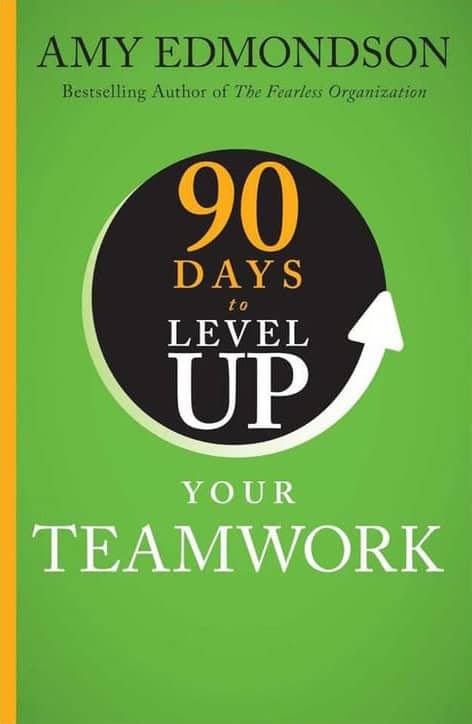
The author of this book is Amy Edmondson, a bestselling author and the Novartis Professor of Leadership and Management at the Harvard Business School. Her work is focused on teaming-dynamic forms of collaboration in environments characterized by uncertainty and ambiguity. She’s also an expert in the role of Psychological Safety in enabling effective teamwork, driving innovation, and delivering superior performance.
Quotes
- “Teams are an organizations’ best change agents”.
- “Teaming is the engine of organizational learning”.
- “Effective teaming rarely happens spontaneously. It takes effort”.
- “Setting boundaries and holding people accountable are critical for a leader hoping to cultivate an environment of psychological safety”.
- “Leadership is needed to help groups build shared understanding and coordinate action”.
- “Teaming requires letting down your guard to work interdependently with others”.
- “Fear is a major barrier to teaming”.
- “Teaming occurs when people apply and combine their expertise to perform complex tasks or develop solutions to novel problems”.
- “Simply put, teaming is a way of working that brings people together to generate new ideas, find answers, and solve problems”.
- “Organizing to learn is a way of moving forward, in spite of uncertainty”.
- “Without conflict, innovation is less likely”.
Structure and contents of the book
The book is built around a 90-Day Plan designed to pace learning, track progress, and focus effort on what has the most impact. The plan unfolds over three consecutive phases, each with clear performance goals: Get ready to learn, innovate, and compete; Team fearlessly with Psychological Safety; and Innovate with teaming. Each phase is broken down into weekly benchmark goals that are described as rigorous but achievable, allowing readers to see immediate progress.
Part I introduces teaming as a dynamic kind of teamwork suited to fast-paced workplaces. It defines how teaming is different than teamwork, explains how work gets done through teaming, and examines the mindset and basic activities required for collective learning. This part introduces the four pillars of teaming—speaking up, collaboration, experimentation, and reflection—and explains why they work and why they are difficult to achieve. Leadership is framed as essential to making teaming possible.
Part II focuses on Psychological Safety: what it is, why it matters, why it is not the norm, and what it is not. It details how leaders create the conditions for Psychological Safety, including framing work well and encouraging voice, while clarifying that safety does not mean immunity from consequences.
Part III connects Teaming and Psychological Safety to innovation through four requirements: Aim High, Team Up, Fail Well, and Learn Fast, showing how intelligent failure and rapid learning enable teams to innovate.
Instructions for reading this book
This book is for leaders, HR professionals, psychological safety practitioners, and professionals at any career stage who want to measurably improve how they collaborate and perform with others. Whether you are new to a role, stepping into leadership, or looking to sharpen your impact, 90 Days to Level Up Your Teamwork is designed to help you build teamwork capability one week at a time, with clear goals and visible progress within a single quarter.
Read it as a 90-day operating manual, not as a linear text. The week-by-week roadmap is meant to be used alongside your daily work: set your personal goals, follow the weekly focus, and apply the practical tasks immediately. Use the summary tables, guided worksheets, and reflective prompts to translate concepts into action, track your progress, and connect what you are learning to real meetings, decisions, handovers, and moments of tension. This is a book to keep open while you work, not to finish and put away.
What makes this volume distinctive is its pragmatic focus. It builds on insights from Edmondson’s previous books and pushes them further by deepening one of the four dimensions that affect psychological safety: willingness to help and teaming. The book includes summary tables and guided worksheets to help readers practice and translate the concepts into action, and features case studies—some revisited and others new—used to clarify rather than impress.
Edmondson’s writing is sober, rigorous, and evidence-based. She writes to stimulate thinking, not to motivate: arguments are developed with precision and restraint. Form mirrors substance—authority without emphasis, clarity without oversimplification. The result is perhaps her most pragmatic book for readers ready to take responsibility for learning, experimenting, and leveling up their teamwork in just ninety days.