
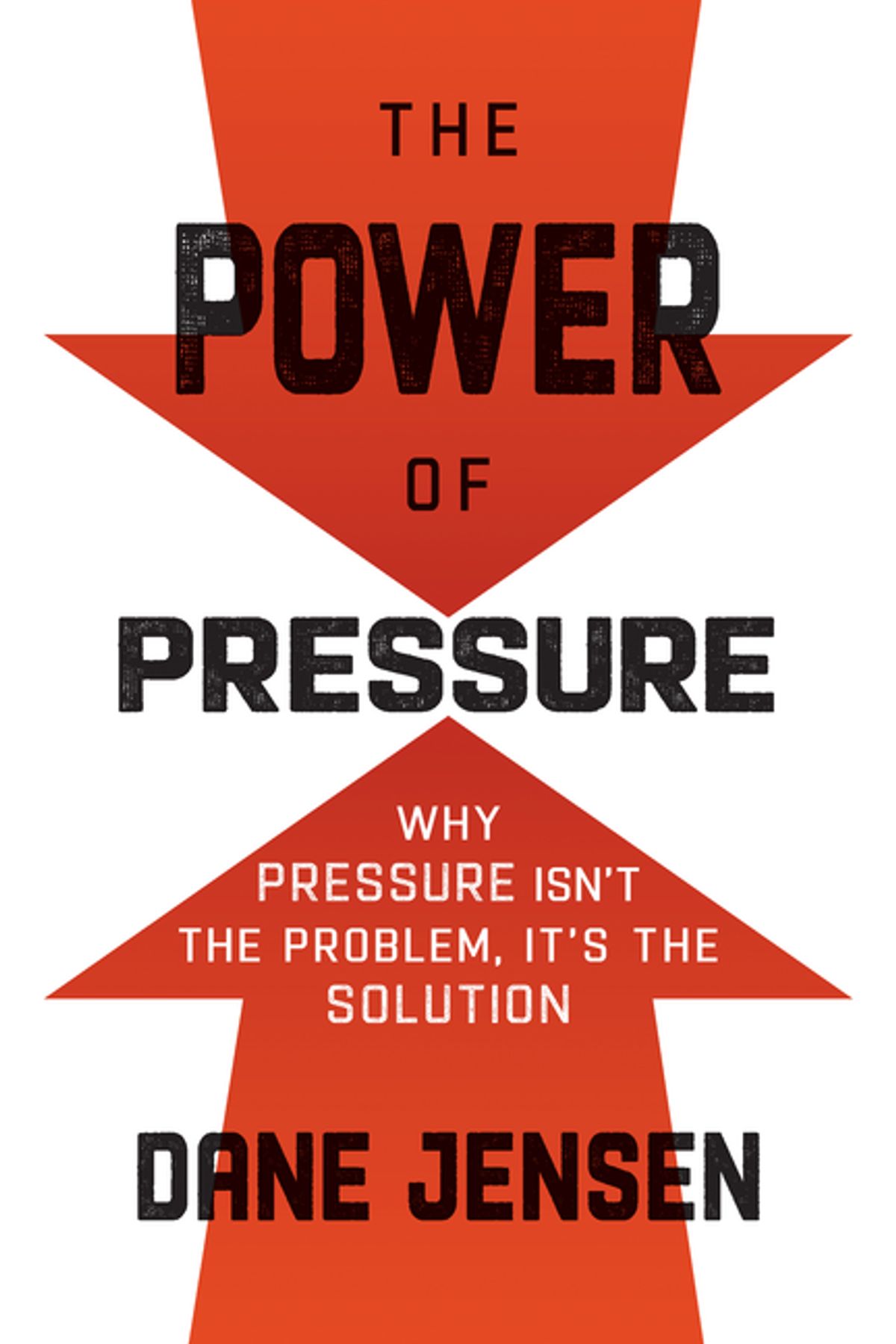
What is important about this book
What’s the most pressure you’ve ever been under? How did you react? What helped? What didn’t?
Over the past five years, the author Dane Jensen has asked these questions to thousands of high performers — from Olympic medalists and Navy SEALs to executives, politicians, and busy parents. What has emerged from these conversations is that while everyone’s experiences under pressure are unique, pressure follows patterns and develops in predictable ways. If we can recognize the patterns, we can improve our ability to sidestep the biological traps that can sabotage us – and use the energy that accompanies pressure to thrive.
The Power of Pressure combines the insights gathered from Jensen’s work with the latest research in biology and neuroscience to help us nail the moments that matter and maintain energy and motivation through the pressures of day-to-day life.
Amy Edmondson, Novartis Professor of Leadership at Harvard Business School, frames it this way: “Imagine what you could accomplish if you could disarm your biggest pressures – then put their energy to work. Jensen shows how in this timely book. Get fresh advice from this book for the next crisis or for your long-term performance”.
Dane Jensen is CEO of Third Factor and helps leaders, athletes and coaches be more effective, creative, and resilient under pressure. His work has spanned twenty-three countries on five different continents.
Quotes
- “Central to managing pressure is realizing that we are not our thoughts, we are not our feelings, and we are not our bodies. These are our tools of action in the world, but they don’t define who we are or what we are capable of”.
- “Pressure is the need to act in the face of important, uncertain circumstances”.
- “If we are going to do things we haven’t done before, we are going to experience pressure […] pressure is a form of energy”.
- “In peak pressure moments, we need to keep our focus squarely on the things we can control”.
- “When we are facing down pressure over the long haul, meaning is a vital ally”.
- “Connecting with self-efficacy is what transforms the experience of uncertainty from one of threat to one of challenge and control”.
- “What distinguishes pressure from other states like stress, fear, or grief is the need to do something […] if something doesn’t matter to you, it won’t create pressure”.
- “Much of the outsized importance that we attach to situations is rooted in how we desire to be seen by others. These stakes are often the ones that cause us the most pressure”.
Structure and contents of the book
At the core of the author’s theory is the Pressure Equation: Pressure = Importance × Uncertainty × Volume, a practical lens for understanding why certain situations create intense psychological and physiological responses. Importance reflects how much something truly matters to you — if it doesn’t, it won’t create pressure. It’s the subjective weight your brain assigns to an outcome.
Uncertainty intensifies that pressure, since the brain experiences unpredictability as a form of pain. Finally, Volume represents the modern overload: a staggering number of important, uncertain things competing for time and mental space—consciously or unconsciously—creating the sense that there’s never quite enough room to breathe.
The Power of Pressure is structured in three parts:
- Understanding Pressure, which defines what pressure is, explains the body’s response, and introduces a model to build awareness of what happens to us when we’re under pressure
- Harnessing the Power of Pressure, which offers concrete strategies to manage long-term pressure and peak-pressure moments.
- Putting It All Together, which focuses on applying these principles in daily life and work.
The book explains how pressure activates the autonomic nervous system and produces real physiological shifts. Pressure is not an enemy to eliminate but a signal to interpret: it’s the ability to use the body’s activation as a resource, not an obstacle — recognizing when it calls for calm and when it calls for action. Pressure is distinct from stress or fear because it demands action. When stakes and uncertainty rise, the body enters an activated state to prepare us to respond. Dane Jensen distinguishes between peak-pressure moments (short, intense bursts) and long-haul pressure (extended periods marked by responsibility, volume, and uncertainty).
Across both forms, becoming pressure ambidextrous is central: the ability to hold the needs of the present and the future together, in a complementary way — staying connected to meaning over time while acting quickly and simply when intensity peaks. It means organizing thoughts, actions, and responses around demands that can sometimes conflict, without being overwhelmed, turning pressure into intentional direction. Key tools include clarifying what matters, accepting uncertainty, focusing on controllable factors, and simplifying to maintain full attention. As soon as we exert control over what we can influence, pressure from uncertainty begins to ease. One essential skill runs through all of this: creating space between trigger and response. Noticing what you feel, think, and experience physically before acting is the foundation of pressure ambidexterity. Under intense pressure, we can lose sight of choice and become our racing heart, anxiety, or thoughts instead of directing them. The book invites readers to reclaim that space and lead from intention rather than reactivity.
Instructions for reading this book
Since the body is the foundation for handling pressure, Jensen encourages us to support it intentionally: sleep well, eat wisely, move regularly, and breathe low and slow. Choose one habit and apply it immediately rather than “later”.
Meaning appears again and again. Use the book to reconnect with why your work matters and to simplify decisions. One clear choice can eliminate a hundred small ones, and routines create predictability when volume and uncertainty rise.
This isn’t a book to read passively: when you encounter the sections on peak-pressure moments, don’t just agree — try them. In overwhelm, act simply and directly: do something, however small. Apply the tools to real pressure moments, not just in theory. Read with your body, not just your brain. Notice sensations, experiment, and act. If you do, you won’t just understand pressure differently — you’ll move through it differently.
The goal of this book isn’t to eliminate pressure. It’s to learn to channel it toward performance and growth rather than reactivity and exhaustion. Our body will activate in important, uncertain situations — and that activation can reveal resources we weren’t aware of.